Landscape Analysis: TECH4Resilience
Advances in technology and AI offer opportunities to develop solutions that respond to disruptions in livelihoods, health systems and food security through approaches that are locally rooted, scalable, and predictive. This analysis maps what the current literature and practitioners tell us about where AI has the potential to strengthen resilience in humanitarian and emergency contexts, as well as providing a snapshot of the current funding and investment landscape.
The report draws on a desk review of peer-reviewed and grey literature, funder and fund documentation where publicly available, insights from our first TECH4Resilience cohort, stakeholder consultation and an open practitioner survey. It covers five application areas: hyperlocal early-warning systems, anticipatory cash and action, health resilience, index and parametric insurance, and displacement forecasting, with adjacent evidence on technology for nature.
Key findings
- The evidence base is uneven: Anticipatory cash has the strongest evidence base and health applications at scale the weakest. In every area, technical feasibility is demonstrated more clearly than sustained resilience outcomes.
- Better models do not replace institutions and response protocols: Advanced models do not remove the requirement for institutional ownership, funded response protocols and locally validated delivery channels.
- Strong dependency on proprietary models: Many Global South innovators and the communities they serve rely on proprietary models and software controlled by a small number of commercial providers.
- The funding and investment spectrum has weak transitions: The landscape shows no shortage of actors with relevant mandates and grant/investment portfolios, however ticket sizes and associated criteria reveal a potential weak transition between the progressive funding levels that are needed for the overall graduation and adoption at scale of a solution.
“AI has enormous potential to strengthen humanitarian
preparedness, but its impact will depend on whether it reaches
the communities that are currently excluded by language, literacy,
connectivity, and accessibility barriers. The greatest innovation
is not only building smarter AI, but making it more inclusive.”
– Maysoon Badi, CEO, Sudan Urban Development Think Tank
The findings point towards an evidence base that is maturing unevenly, in which technical feasibility is demonstrated more clearly than sustained resilience outcomes. Anticipatory cash has the strongest evidence base and health applications at scale the weakest; hyperlocal early-warning systems show clear gains in forecast accuracy and coverage alongside limited evidence that AI-enhanced warnings consistently reduce losses.
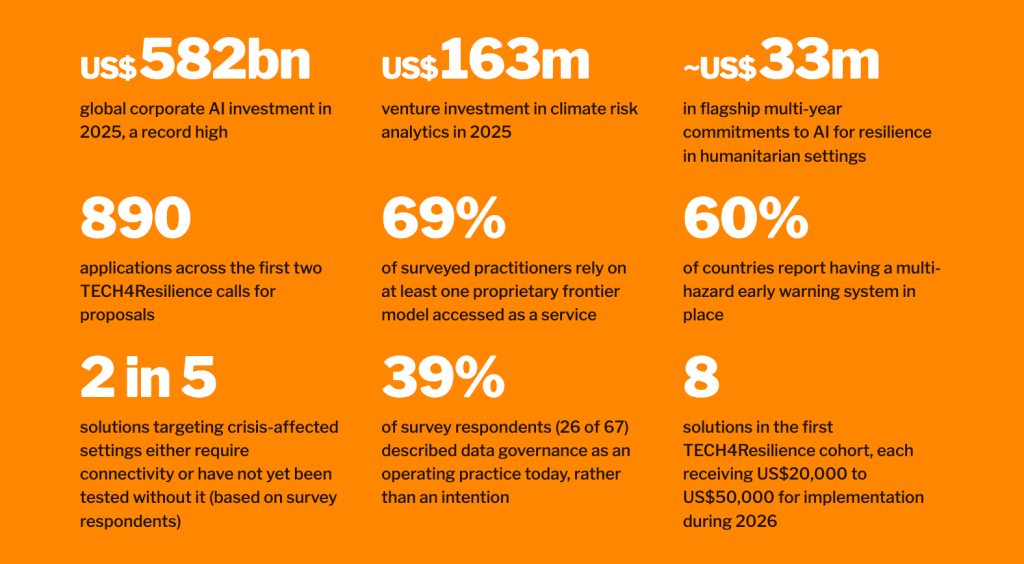
Advanced models do not remove the requirement for institutional ownership, funded response protocols and locally validated delivery channels. The survey points to a further structural dependency, as 69% of respondents rely on at least one proprietary model accessed as a service. The analysis is published at a point when AI capabilities are quickly advancing and being integrated into the systems and programming of humanitarian and development actors, frequently ahead of a robust evidence base.
The AI divide need not become the next development divide. With deliberate investment, shared standards and coordinated action, AI can strengthen the resilience of those most exposed.